The Return on Investment of Sustainability – It’s Here!
A common misconception persists in the agricultural sector: that MRV is primarily an administrative burden imposed by regulatory frameworks such as the CSRD or voluntary carbon standards.
Real-world deployments show the opposite. Digital MRV infrastructures generate a measurable return on investment across the entire agricultural value chain—by reducing operational costs, unlocking the value of agronomic gains, and strengthening the strategic resilience of supply chains.
This article draws on independent studies conducted by leading consulting firms, combined with data from operational deployments in Europe. It focuses on three complementary perspectives:
- a short-term operational ROI*,
- a medium-term economic ROI*,
- a long-term strategic ROI*.

CONTENTS
First and foremost: What is MRV, and what data are we talking about?
1. Operational RSI: Reducing the Cost of Sustainability Data
a) The structural problem of fragmented reporting
b) A widely documented observation beyond agriculture
c) What a digital MRV changes
d) Measured gains in the field
e) The scale effect: A compelling argument for cooperatives
2 Economic RSI: Unlocking the Value of Sustainable Agricultural Practices
a) Real agronomic gains—but invisible without measurement
b) The central paradox of the transition: real but invisible gains
c) MRV-specific RSI: transforming invisible gains into economic value
3 Strategic RSI: Securing Supply Chains and Markets
a) Unprecedented exposure to systemic risks
b) From optimization to resilience
c) Market signals are converging
d) A strategic repositioning for cooperatives
4. What about the CSRD’s rollback? What the Omnibus Package changes—and what it doesn’t
a) What the Omnibus package does not change
b) What the Omnibus reveals, by implication
First and foremost: What is MRV, and what data are we talking about?
MRV stands for Monitoring, Reporting, and Verification. It refers to the set of processes used to collect data on agricultural practices, convert them into standardized indicators, and ensure their reliability to third parties (buyers, auditors, funders, regulators).
Agricultural sustainability data covers three complementary dimensions:
- Agricultural data
e.g., yields, soil health, biodiversity, water management, farming practices (cover crops, crop rotations, tillage, etc.) - Environmental data
e.g., greenhouse gas emissions, carbon sequestration, nitrogen balance,
use of inputs - Socioeconomic data
e.g., farm income, workload, farm viability, working conditions
Historically, this data was collected in a fragmented, self-reported, and un
manner that was difficult to verify. Digital MRV (dMRV) is a game-changer by interconnecting existing source
—agricultural management tools (parcel management), machine data (tractors, harvesters, etc.), field observations, and CAP declarations—to produce robust, traceable, and comparable indicators without increasing the administrative burden on farmers.
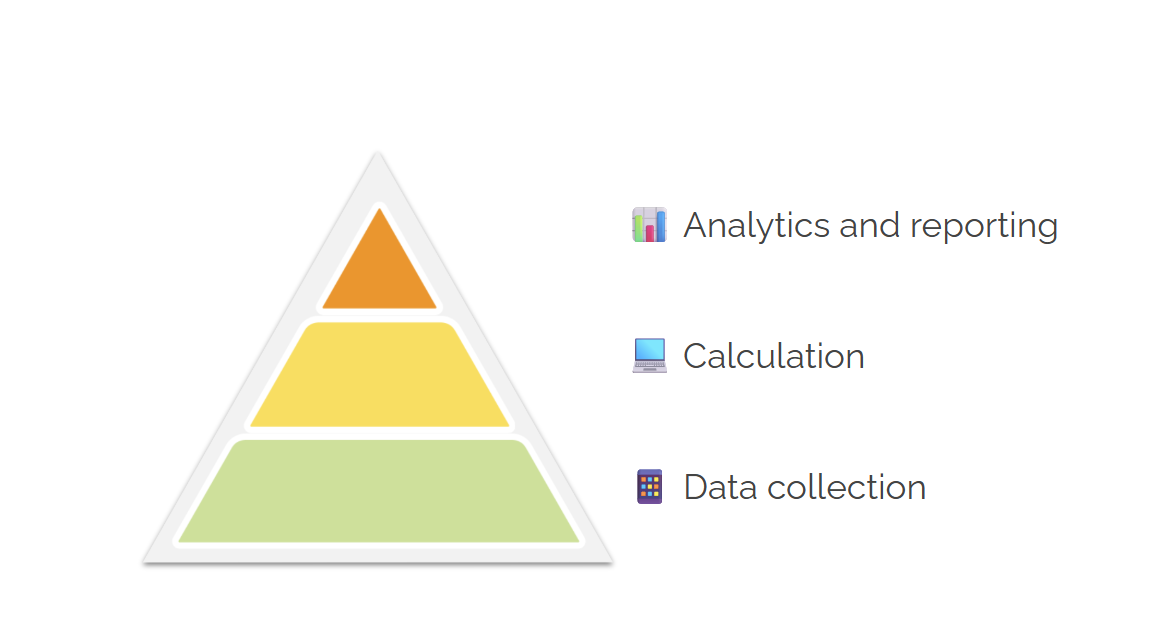
MRV Structure Pyramid
This pyramid illustrates the logic behind dMRV: raw field data is collected at the base, transformed into indicators at the intermediate level, and made available to decision-makers at the top—farmers, advisors, cooperatives, and manufacturers, each at their own level of analysis.
1. Operational RSI: Reducing the Cost of Sustainability Data
(a) The structural problem of fragmented reporting
The primary benefit of a digital MRV is immediate: it reduces the burden of collecting, consolidating, and reporting sustainability data.
For a long time, agricultural reporting has relied on fragmented processes—spreadsheets, surveys, and multiple disconnected databases. These systems have three structural flaws that are often underestimated.
- A high human cost. Each data collection campaign requires field advisors to perform data entry and consolidation tasks that add no agronomic value. This time is all the more valuable given that advisory teams are often stretched thin.
- A risk of systemic error. When data is transferred manually via spreadsheets between the field and headquarters, data entry errors, duplicates, and inconsistencies accumulate. It is difficult to guarantee the reliability of the resulting indicators—and even more difficult to audit them.
- It’s impossible to scale up. A manual process that works for 50 farms becomes unmanageable for 500, and impossible for 5,000. Yet the agricultural transition cannot be managed on the scale of a pilot project.

Reducing the Cost of Sustainability
(b) A finding that is well documented beyond the agricultural sector
This is not a situation unique to the agricultural sector. A KPMG benchmark (2025) covering 51 CSRD projects across 14 sectors reveals that 65% of companies report major difficulties in collecting data prior to their sustainability reporting, that 71% still rely on traditional office software solutions, and that only 24% have adopted dedicated digital tools.⁹
In financial terms, CSRD compliance entails an average budget of €50,000 to €200,000 per company—which can exceed €600,000 for larger firms—with an estimated additional workload of 1 to 2 full-time equivalents for two-thirds of the organizations affected.¹⁰
Sustainability reporting without the right tools is already very costly. MRV isn’t an additional cost—it’s the streamlining of an expense that’s already been incurred, with far greater reliability.
c) What a digital MRV changes
(d) Gains measured in the field
As part of a global agricultural sustainability program led by a major consumer goods company, field consultants saved three hours per farm during data collection, while the sustainability teams at headquarters saved 40 hours of work on data consolidation and analysis.¹
As part of a low-carbon initiative supporting the agricultural suppliers of a major European brewing group, these suppliers saved up to two days of work in producing their sustainability reports.¹
These examples confirm a reality that is often overlooked: the cost of not implementing MRV is far greater than the cost of implementing MRV—in terms of lost hours, the risk of errors, and vulnerability to audit scrutiny.
e) Economies of scale: A compelling argument in favor of cooperatives
A major European sugar cooperative calculated the Scope 3 emissions of its entire network —more than 9,000 farmers and 160,000 hectares of crops.¹ Thanks to an interface designed to minimize data entry, each farmer provided the necessary data in about 15 minutes. Across the entire network, this volume of data would have required several man-years of work using a traditional manual approach.
By simplifying reporting while improving data reliability, MRV is transforming sustainability: rather than being a recurring burden, it becomes a productivity driver for CSR teams, field advisors, and farmers themselves.

2. Economic RSI: Unlocking the Value of Sustainable Agricultural Practices
a) Real agronomic gains—but ones that are invisible without measurement
Before addressing the MRV’s RSI as such, it is necessary to distinguish between two concepts that are often confused.
Sustainable and regenerative agricultural practices—cover crops, reduced-
-till farming, diversified crop rotations—generate documented agronomic and economic benefits. These benefits exist independently of any digital tool: they result from changes in the farmer’s practices and belong to the farmer regardless of whether they use an MRV system or not.
Several independent studies confirm this. A McKinsey & Company study (2024) estimates that farmers adopting regenerative practices can generate net gains of €50 to €150 per hectare per year over a ten-year period, resulting from a combination of reduced inputs, improved soil fertility, and greater resilience to climate hazards.²
A study by PwC Germany and Klim (2025), conducted over several years on a German grain farm, shows that regenerative practices can simultaneously increase wheat yields by 7% and reduce greenhouse gas emissions by 30%.³
These results are real and significant. But they raise a fundamental question: what happens if no one can prove them?
b) The central paradox of the transition: real but invisible gains
This is the structural paradox facing many agricultural sectors today. Sustainable practices improve soil health, reduce inputs, and enhance climate resilience—but these positive effects are lost in the average sector-wide indicators, buried in generic data that fails to distinguish a farmer in transition from a conventional farmer.

Regenerative agriculture and sustainable practices
This isn’t just a theoretical assumption: it’s what the stakeholders themselves confirm. According to a survey conducted by the SBTi among companies engaged in decarbonization efforts, 85% of them report that access to reliable data is the main obstacle to establishing a solid baseline, with particularly significant difficulties in obtaining indicators specific to agricultural suppliers.¹¹
Without primary data at the farm level, it is impossible to validate climate goals—or to demonstrate progress toward them.
The result: farmers who change their practices do not receive a differentiated price signal. Cooperatives cannot demonstrate the value of their commitments to downstream stakeholders. Manufacturers cannot establish the credibility of their Scope 3 emissions trajectories. The value created on the ground remains invisible—and therefore goes unrewarded.

Would you like to find out more and talk to our experts?
(c) The MRV-specific RSI: converting invisible gains into economic value
This is where the unique value of the MRV lies. Its role is not to generate agronomic benefits—it is the farmer who generates them through their practices. The MRV’s role is to make these benefits measurable, traceable, and auditable—and thus to create the conditions for their economic valuation.
Specifically, four value-creation mechanisms become operational through a robust MRV system:
1. Sector-specific premiums. Cooperatives and manufacturers can structure purchase contracts that reward demonstrated environmental performance—rather than generic certifications or statements of intent. This serves as a tool for retaining high-performing producers and for commercial differentiation downstream.
2. Certified carbon credits. Voluntary carbon markets reward carbon sequestration in soils and reductions in agricultural emissions—but only if these results are verified through MRV that complies with recognized standards (such as the Low-Carbon Label in France, Verra, or the Gold Standard internationally). Without MRV, there are no credits. With MRV, every ton of CO₂ sequestered becomes a source of additional income in a market where the 2025 European Carbon Farming Barometer highlights growing interest.⁵
3. Performance-based contracts. Some pioneering sectors are beginning to link a portion of payments to verified environmental performance indicators—paving the way for a model in which the data generated by farmers becomes an economic asset in its own right.
4. Access to green finance. An emerging yet transformative trend: sustainability-linked loans—loans whose interest rates are tied to the achievement of environmental KPIs—now account for more than 70% of sustainable dollar-denominated loans issued between 2020 and 2024.¹² This mechanism is gradually expanding into agriculture: in April 2025, the Climate Bonds Initiative published a framework dedicated to the agrifood transition, already inspiring agricultural cooperatives—such as the Swedish cooperative Lantmännen—to issue green bonds backed by verified environmental performance indicators.¹³
For cooperatives, MRV thus presents a direct opportunity: to develop differentiated commercial offerings based on field-
, and to reposition
their role in the value chain—no longer as mere collectors, but as guarantors of their members’ sustainable performance and facilitators of access to new sources of financing.
3. Strategic RSI: Securing Supply Chains and Markets
(a) Unprecedented exposure to systemic risks
The most transformative benefit of MRV is realized over the long term. Agricultural supply chains face growing and simultaneous risks: climate variability, resource constraints, stricter regulations, and increased demands from investors and clients.

The Importance of MRV for Supply Chains and Markets.
On the regulatory front, pressure is mounting on several fronts. The CSRD is gradually requiring large companies to publish verified impact data on their agricultural supply chains, with requirements for granularity and auditability that make self-reporting untenable.⁴ The SBTi FLAG framework, mandatory since 2023 for all agri-food companies wishing to submit recognized climate targets, now requires third-party verification of baseline data and provides for unannounced audits between reporting cycles.¹¹ These two frameworks point to the same reality: without reliable primary agricultural data, sector commitments can no longer be validated.
When it comes to reputation, amid widespread suspicion of greenwashing, the credibility of sustainability commitments becomes a key differentiator—or a catastrophic liability if there is a disconnect between statements and reality on the ground.
b) From Optimization to Robustness
In light of these cumulative risks, the work of Olivier Hamant (INRAE) provides a structured analytical framework. His research shows that, in environments subject to repeated and unpredictable shocks, the challenge is no longer the constant optimization of performance, but the ability to continue functioning despite disruptions⁶ — what he calls robustness.
When applied to agricultural supply chains, this framework reverses priorities. The goal should not be to maximize average yields or minimize short-term costs, but to secure long-term production capacity. MRV becomes the tool for managing this resilience: it enables a shift from management based on averages—which mask vulnerabilities—to supply management based on individual, verified, and up-to-date data.
(c) Market signals are converging
A Deloitte report (2024), conducted in partnership with NYU’s Center for Sustainable Business and surveying 350 agri-food executives, shows that 99% of companies that have implemented sustainability initiatives beyond mere declarations have recorded revenue growth, and 98% have reduced their operating costs.⁷ These figures should be interpreted with caution: they partly reflect a selection bias—companies that invest seriously in sustainability are also those that manage their overall operations more effectively. However, they indicate a strong correlation between management maturity and economic performance.
The work of the Forum for the Future (2023) identifies shared measurement frameworks among stakeholders as one of the key factors in scaling up regenerative agriculture.⁸ It is not a lack of goodwill— it is the absence of a common measurement and verification infrastructure needed to align decisions and investments.
d) A strategic repositioning for cooperatives
For cooperatives, this is a particularly sensitive strategic issue. They occupy a pivotal position in the value chain: in direct contact with farmers on one side, and under increasing pressure from manufacturers and retailers on the other.
Having a robust MRV system means being able to offer downstream partners guarantees of traceability and performance that declarative systems can no longer provide. It also means being able to offer members value-added services—individualized reporting, access to carbon markets, support in securing differentiated contracts and green financing—that strengthen loyalty to the cooperative
in an increasingly competitive environment.

Would you like to find out more and talk to our experts?
4. What about the CSRD’s delay? What the Omnibus Package changes—and what it doesn’t
It is difficult to discuss the strategic return on investment of MRV without mentioning the elephant in the room: the Omnibus Package adopted in April 2025, which postpones CSRD requirements for waves 2 and 3 by two years, excludes approximately 80% of the companies initially targeted by raising the threshold to 1,000 employees, and reduces the number of mandatory data points from 1,200 to 320.

CSRD Standard
For stakeholders whose implementation of an MRV system was primarily driven by regulatory requirements, this is a clear sign of a slowdown. It would be misleading to deny this.
But it would be just as inaccurate to conclude that the pressure on the agricultural sectors is easing with Brussels.
a) What Omnibus does not change
The large companies in Wave 1—multinational food and beverage companies, publicly traded industrial groups, and large cooperatives above the threshold—are already part of the system and are not leaving it. Their SBTi commitments, their obligations to institutional investors, and their contracts with international retailers maintain pressure that is independent of the European regulatory timeline.
The SBTi FLAG framework, on the other hand, is a private voluntary standard: it was not affected by the Omnibus Act, and its requirements for third-party verification of agricultural data continue to apply to all companies committed to validated climate targets—now numbering more than 10,000 companies worldwide.¹¹
Market pressure, after all, does not simply disappear with regulation. A manufacturer that has made public commitments to Scope 3 decarbonization will continue to demand data from its suppliers and partner cooperatives, regardless of whether there is a legal requirement to do so. The chain of responsibility extends downward even as formal requirements are imposed upward.
b) What Omnibus reveals, by implication
The easing of regulations actually has a paradoxical effect: it distinguishes serious industries from those that were waiting for mandatory requirements before taking action. When everyone had to comply, MRV was a ticket to entry. As the requirement is relaxed, it becomes a signal of strategic positioning—that of organizations that have understood that data-driven sustainability is not a response to regulation, but a prerequisite for their competitiveness ten years from now.
The real question raised by Omnibus is therefore not: “Should we still invest in an MRV?” but rather: “Which of our competitors will use this respite to widen the gap?”
5. In summary
MRV does not create agronomic value—it is the farmer who creates it through their practices.
MRV creates the conditions for this value to be recognized, demonstrated, and compensated—for the supply chains as well as for the farmers who are the driving force behind them.

The three dimensions of RSI are not three separate concepts. They form a coherent chain in which each level reinforces the next: operational gains free up resources, which enable investment in measurement, which lends credibility to strategic commitments and opens the door to new markets and financing.
It is this cumulative logic—and not merely regulatory constraints— that makes MRV not just another reporting tool, but a transition infrastructure. An infrastructure that forward-thinking sectors do not merely endure: they choose it.
Methodological Note
The use cases cited in this article are drawn from projects conducted by MyEasyFarm, a European agricultural MRV platform, in collaboration with cooperatives and international agri-food groups. Client names have been anonymized; the figures correspond to data collected during operational deployments between 2021 and 2025. Renaud Loesel is an associate consultant at MyEasyFarm in MRV strategy and agricultural transition.
Take your transition to the next level with MyEasyFarm
The agroecological transition should no longer be viewed as a regulatory constraint, but rather as a structured path toward sustainable performance. At MyEasyFarm, we don’t just provide you with a tool: we become your methodological partner to Measure, Monitor, and Transform your practices into concrete, valuable results. Whether you’re an agri-food company, a cooperative, or a farmer, our platform simplifies your most complex projects by ensuring full transparency across your value chain.
📩 Contact our experts to find out how our platform adapts to your projects and accelerates your impact.

Would you like to find out more and talk to our experts?
Notes and References
¹ Data from MyEasyFarm deployments MyEasyFarm 2021–2025) — anonymized client cases.
² McKinsey & Company (December 2024). Revitalizing Fields and Balance Sheets through Regenerative Farming. Estimates based on field crop farms in the United States (corn, soybeans); order of magnitude applicable to Europe with adjustments based on soil and climate conditions.
³ PwC Germany & Klim (January 2025). Practical Guide to Regenerative Agriculture. Multi-year study conducted on a German grain farm.
⁴ European Commission — CSRD (Corporate Sustainability Reporting Directive), phased implementation 2024–2028. Omnibus Package adopted in April 2025: 2-year postponement for Phases 2 and 3, threshold raised to 1,000 employees, reduction to 320 mandatory data points.
⁵ Climate Agriculture Alliance & GreenFlex (February 2025). European Carbon Farming Barometer.
⁶ Hamant, O. (2022). The Third Way of Life. Odile Jacob.
⁷ Deloitte & NYU Stern Center for Sustainable Business (March 2024). Unleashing Sustainable Value in Food & Agriculture. Survey of 350 agri-food business leaders who have implemented structured sustainability initiatives.
⁸ Forum for the Future (2023). Scaling Regenerative Agriculture in the UK: Accelerating Change through Collaboration.
⁹ KPMG France (2025). Benchmark on CSRD Projects — Feedback on 51 CSRD projects across 14 sectors.
¹⁰ College of Sustainable Development Directors — C3D (2024). Survey on costs and resources mobilized for CSRD compliance, cited in Youmatter (2024).
¹¹ Science Based Targets initiative — SBTi FLAG Guidance (2023) & Corporate Net-Zero Standard V2 (draft, 2025–2026). SBTi survey on barriers to decarbonizing agricultural value chains: 85% of companies cite the lack of reliable data as the main barrier.
¹² Environmental Finance (2024–2025). Share of sustainability-linked loans in the sustainable lending market in USD (2020–2024).
¹³ Climate Bonds Initiative (April 2025). Agrifood Transition Framework. See also: Lantmännen Green Bond Framework (March 2024) and Landshypotek Green Bond Framework (September 2025).